
By Gary Tomlin
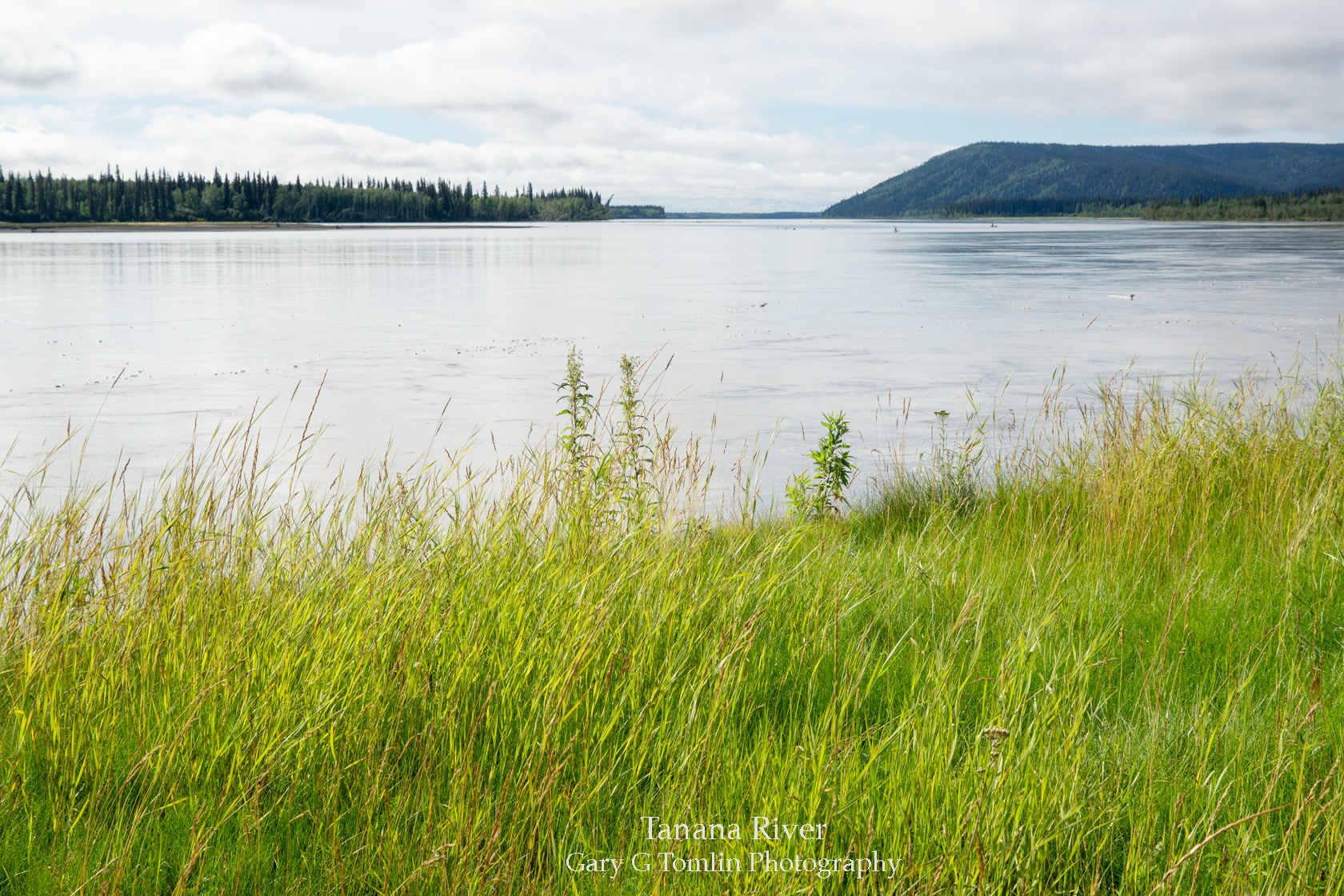
Tanana River, Alaska. July, 2025 –The Tanana is the second largest river in Alaska, and the largest tributary in the Yukon River watershed. It drains the north slope of the humongous Alaska Mountain Range, and eventually joins the Mighty Yukon about 100 miles northwest of Manley Hot Springs.
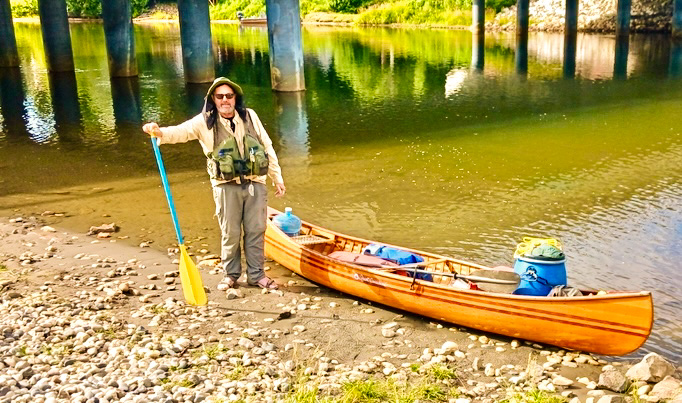
Photo by Sid Parish
I planned to paddle from Fairbanks to my basecamp in Manley in five, 30-mile days. Not too strenuous, but a good pace for an old man. It should be an easy, relaxing trip. As it turned out, I had to deal with one goofy damn thing after the next all the way down that river.
I brought enough food for seven days. The food is simple. The goals are simple. Life has no choice but to be simple during river travel. The days start with drip-brewed coffee and contemplating the flowing water; considering its challenges and hazards; anticipate where it will take me; speculate on what it might show me.
As rivers go, this is a young river, and like a teenager, it’s demanding, tricky, unforgiving, fast and shallow, and it hasn’t yet figured out where it will cut its final flow.
It’s a formidable challenge. Not for a novice. To paddle it, you need to know how to read a river’s channel, assess its character and play its waters. Except for their Eskimo Rolls, it’s pretty much what the whitewater enthusiasts do, but slower and spread out in meandering flow.
The upper half has free range across its wide basin. Long braids of shallow water flow parallel to, and are separated from the current’s main channel by miles-long, skinny sandbars.
The lower half starts acting like regular river with cutbanks and proper islands.
The days flow to the rhythm of the river. It takes the same amount of time every day to set up camp, cook dinner and make the bed, and the only obligation of the day is to find a campsite with enough time to do those chores before dark. In the land of the midnight sun it is not difficult.
It doesn’t really matter when you wake up, start out in the morning, or how far you go. The mornings are special time in Nature. No schedule. No clock. Just cognizance of when it is going to get dark.
—————————————————————-
The exertion of paddling throughout the day, day after day, becomes a celebration of fitness.
—————————————————————-
There are odd and unpredictable water challenges on this river like the shallow river bottom for example: when the Ruby Marine barge went by, which is a stout, low-draft tugboat pushing two, low-draft, cargo barge sections, I pulled up next to a sandbar and waited.
After it passed, I set a 45° angle to cut across the anticipated wake, and started paddling towards the channel. No wake! Odd? When I got to the channel I realized the water displacement of the barge pushed down, but not very far, to the bottom and bounced back up. The waves of energy were stuck in the channel, bouncing up and down, and not dissipating out across the water-plain like a normal wake. The confined energy intensified the water’s action, and it lasted several minutes.
I paddled into this mess?
There was no order or wave pattern. The chaotic water was more like floating in a pan of boiling water, and I was bobbing around in the middle of it. The paddle was less than useless. The only thing I could do was to lean forward to lower my center of gravity, and grip the gunnels. This allowed me to shift my weight quickly in any direction and counter-balanced the canoe’s erratic up, down and sideways throws. This kept it from flipping or rolling in the wildly turbulent water.
It’s a good, strong boat, and confidence came with good weight distribution. I bounced along like a bull rider; thinking this is fun, but wishing it would quit. Long minutes.
—————————————————————-
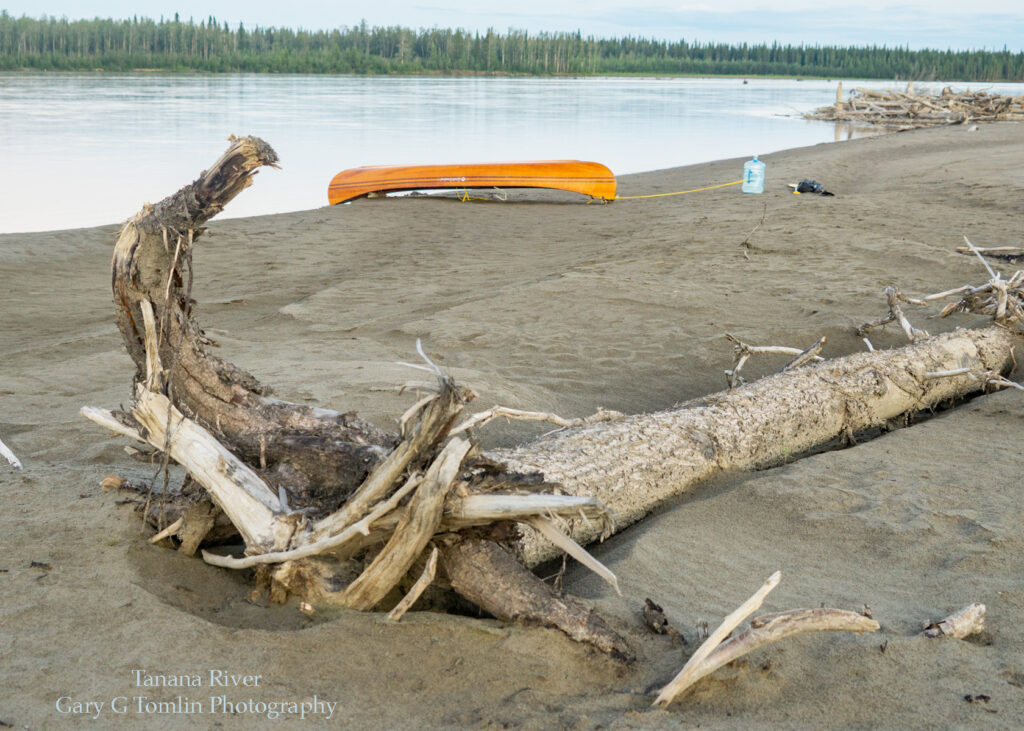
The first evening, as I made camp on the sand bar. A single engine airplane flew over and its engine was cutting out. It sounded like the pilot was struggling to keep it in the air, and it looked like I was going to be the first responder to a crash. They circled, the motor stopped, lost altitude, restarted and then went back up. I grabbed my paddle and lifejackets, untied the boat, gathered the first aid kit and what tools, ax and such, as I had, and waited anxiously by the boat to paddle to wherever the crash would be. It didn’t happen.
They started doing touch-and-goes on the sandbars around me, and I figured out I was watching a student bush-pilot practice doing engine cuts for touch & goes, and when they got comfortable with that, started doing actuals. It’s their first step in learning how to land and take off where there are no runways.
That got me thinking about rescues. When I go into the wilds, I don’t carry a tracking device, and I deliberately don’t leave detailed information of my plans, routes and schedule. For these reasons: it’s like leaving one foot on the base. It confines and dilutes the adventure to be bound by a schedule. Anything I get my dumb ass into, I have to get it out. And, I absolutely do not want anybody taking risk or getting hurt to come after it. Forest Rangers, hunters and those types tell me this is stupid and dangerous, but actually it’s the opposite. When I know there can be no rescue, it greatly increases my caution and diligence.
—————————————————————-
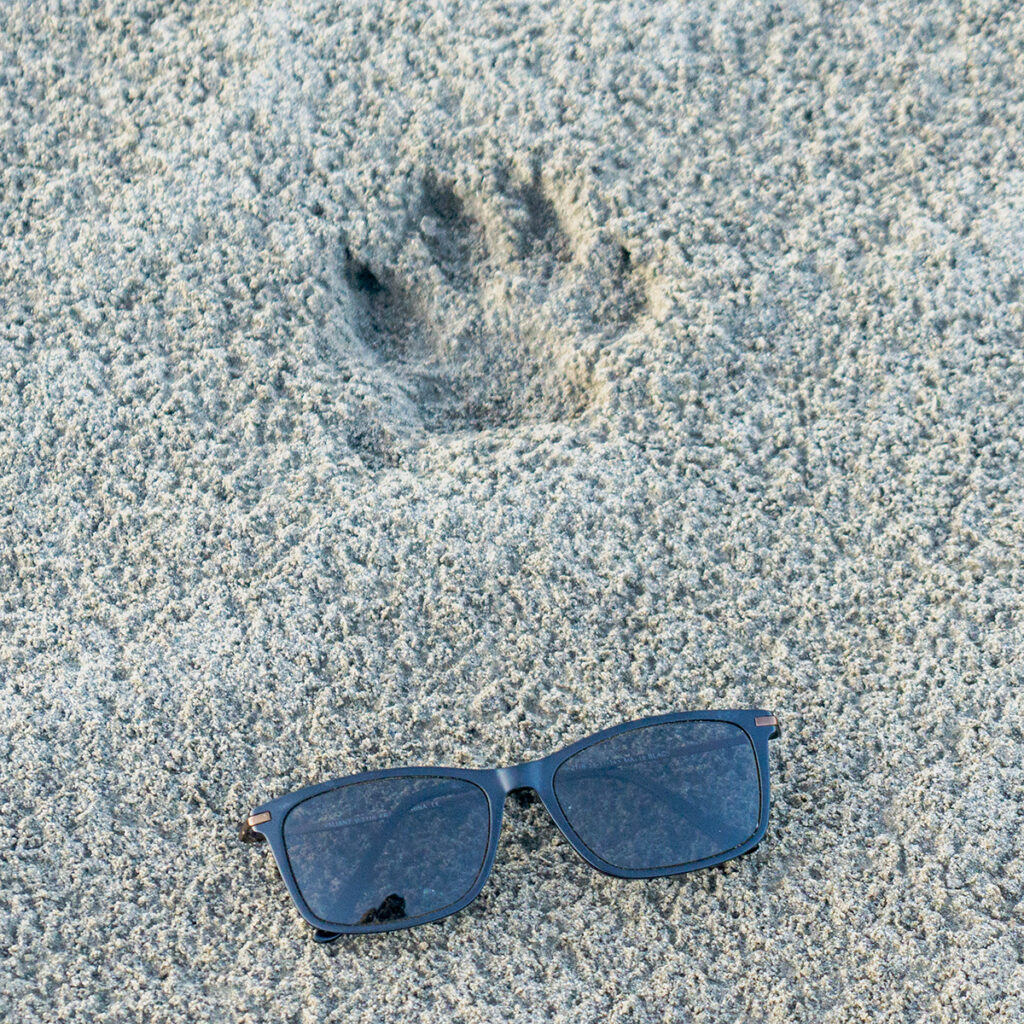
Meaningful prayer
—————————————————————-
On the second day, I came to a log jam that crossed half of the river. I’ve never seen such a big log jam standing up to such a strong current. From my angle, at water level and going into a downstream bend, it looked to be blocking the whole river, but I was certain the water wouldn’t allow that.
I had to paddle cross-current, like a bee was chasing me, with faith that there would be an opening beyond what I could see, and to get far enough across the river to clear the jam before the current pushed me into it. I cannot imagine a more helpless and hopeless situation than being pinned up against a big water log jam, by a big water current.
Type II Fun kicked in: push all distracting thoughts and fears from consciousness. Total focus. No margin for error. Craft maximum efficiency from every stroke. Don’t let up. No matter how hopeless it looks, see it through.
It looked like I was going to be totally screwed, but the break in the jam came, just before I ran out of water separating me from it. It wasn’t life threatening, but it would have destroyed the boat, taken all my gear, and left me banged up and sitting in a pretty rough spot.
EXHILARATING!
In hindsight, I realized that, initially, I could have turned the boat upstream and paddled against the current, swung wide around the whole mess, and never gotten near the log jam, but that didn’t occur to me in the moment.
———————————————
Somewhere around old Minto: It was late in the afternoon of the third day, when I saw a lightning bolt, and the thunderhead was headed my way. I needed to get off the water now, and may as well stop for the night.The closest place that might give suitable camping was on the other side of the river. It was 300 yards, and most of that would be over low water and a submerged sandbar. It was my best option, and I hoped the boat didn’t run aground.
Picture what follows as a Clown Act:
The canoe ran aground, about 20 yards from shore. The storm was getting closer.
I had to get out and drag the boat the rest of the way. The Velcro toe straps on my sandals were released for my paddling comfort, and I neglected to tighten them when I stepped into the epoxy-like mud and ankle deep water. Without the toes being strapped, the grip of the mud immediately pulled the sandals from my feet, and they were dangling by the ankle straps. My bare feet were probing for sharpies on the river bottom.
It was a two-handed job to reattach the sandals.
Without my weight, the boat floated, and the current was strong enough that it started to float away every time I let go to fix my shoes. I had to get back into the boat and drip river muck all over the floor to tightened the sandals. Then I got out again and started pulling the boat behind me towards shore.
Each step was a struggle to extract my feet and advance across the sticky mud. Twice, my momentum put me on my knees when the mud would not release my step, and the canoe goosed me. It was the opposite of quicksand, and with a clown’s clumsiness, I made my way to solid ground.
—————————————————————-
I claim a humble presence in these one-on-one meetings with Nature. Far from the noise and works of man. Senses are massaged day and night by uninterrupted quiet. It cannot be imagined what the absence of sound sounds like. You have to get pretty deep into the wilderness to remove the noise of human activity, but it is astounding when you realize you are hearing nothing. True quiet — it feeds the Soul.
—————————————————————-
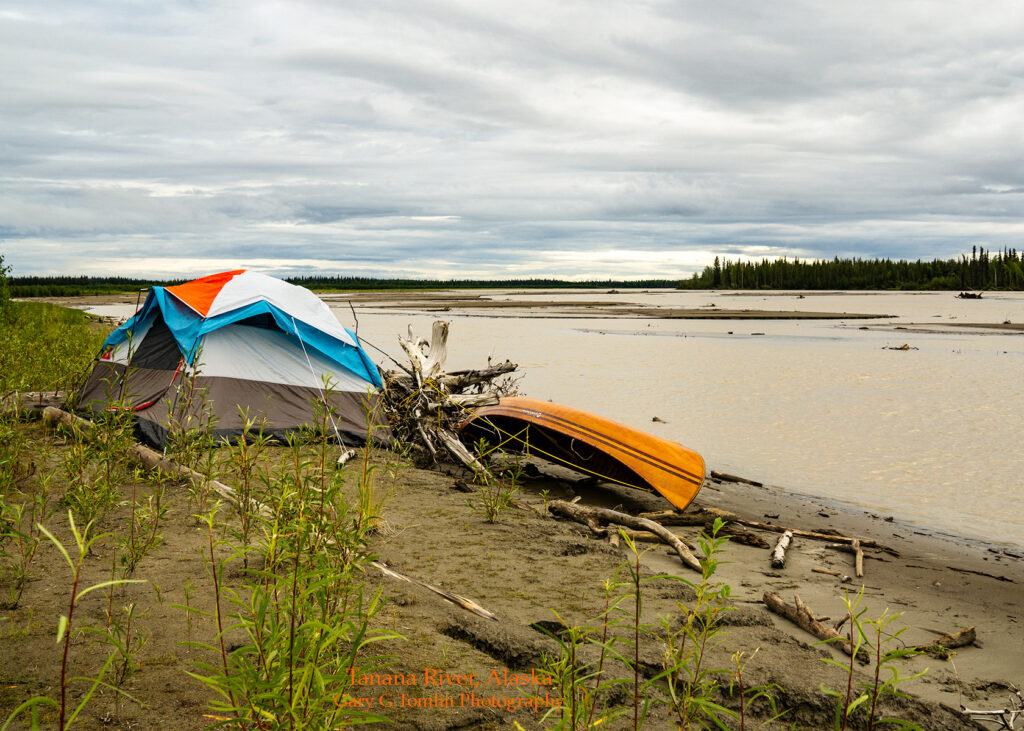
This won’t be the first time I’ve pitched a tent in a rainstorm, but it was certain to be the next time. Not fun. I started running through the memories for lessons from similar beatings I’ve taken in the past.
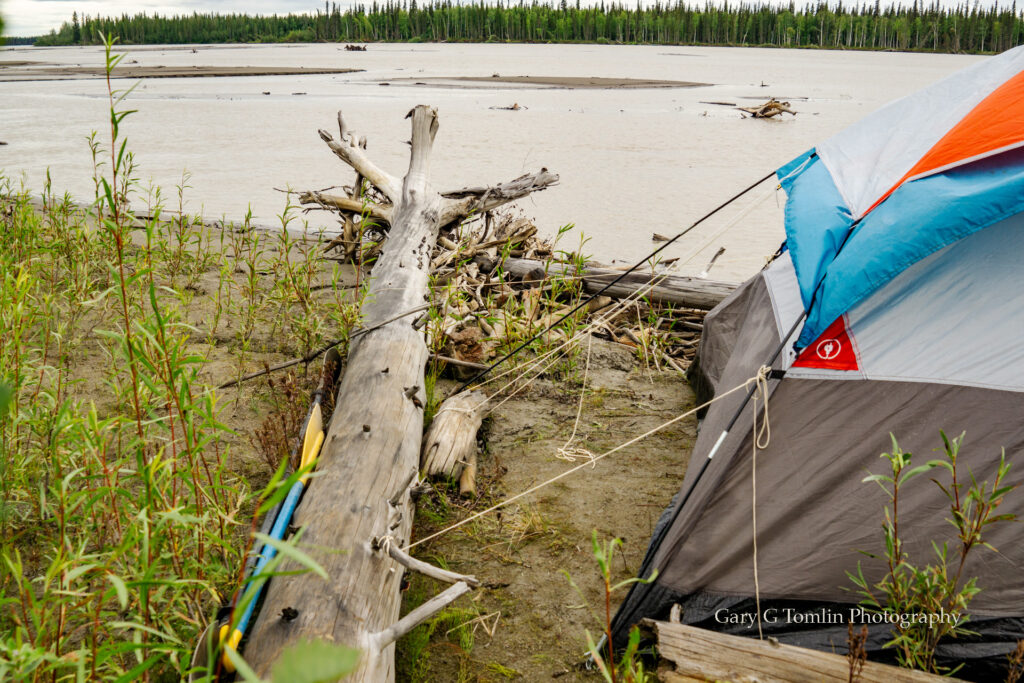
One was to pick a tent site on the leeward side of a decaying tree trunk. It makes a great structure to tie essential guy ropes to the tent’s poles, and it gives the tent a partial wind block. Guys strengthen the tent’s stand against the wind, and a tree trunk is a stronger anchor and much faster to rig to, than making stakes out of driftwood and driving them into the sand.
The beach was level, dry sand, and I had to lop off about 20 willow saplings in the tent’s footprint. I pack a short-handled pruning lopper, and it made short work of this task.
With a sudden temperature drop, and a big gust of wind, the harsh pelting started. Steady rain, not overpowering, and less abusive than other storms that have humbled me. I could sense this one intended to settle down and stay a while.
It was a cheap tent, I bought it to use for beach camping down on the Baja Sur a couple of years ago. Thought I’d give it a try in the bush.
Anytime I ever bought a tent, I assumed it would be waterproof. I wouldn’t even think to ask the question.
When the rain came down hard, the material turned out to be porous and the water ran down the inside walls. The floor and six inches up from the ground was made with stronger, waterproof material, so the rain pooled on the floor. Fortunately, not through planning but Providence, the high spot of the footprint was in the middle, and a moat of water formed around the inside parameter of the tent. The door of the tent was the low point of the footprint, and when I pushed the threshold down the moat would drain.
In my basic gear, I carry a 6’ x 6’ blue tarp, and I was able to lace that down under the porous rain fly, and that stopped the leaking and repelled the water adequately for the next two days.
It is healing to wake up and know you are alone in the loving embrace of your Mother. Safe from everyone and everything. Top of the food chain and no other biped feeders around.
—————————————————————-
Tolovana Roadhouse: Day 6
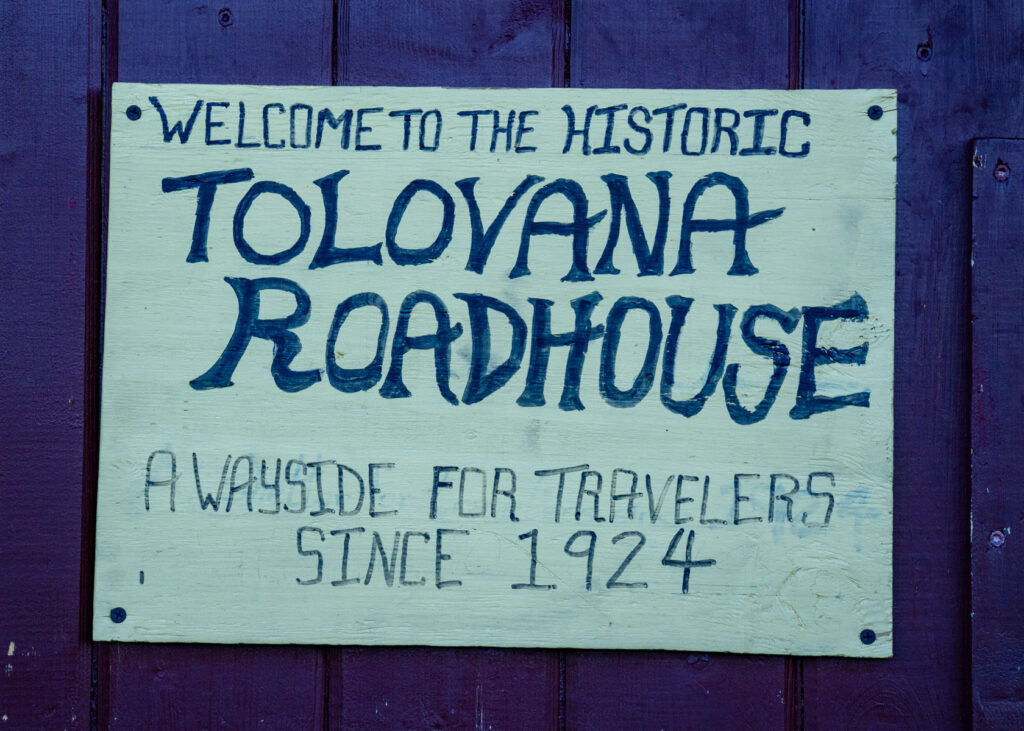
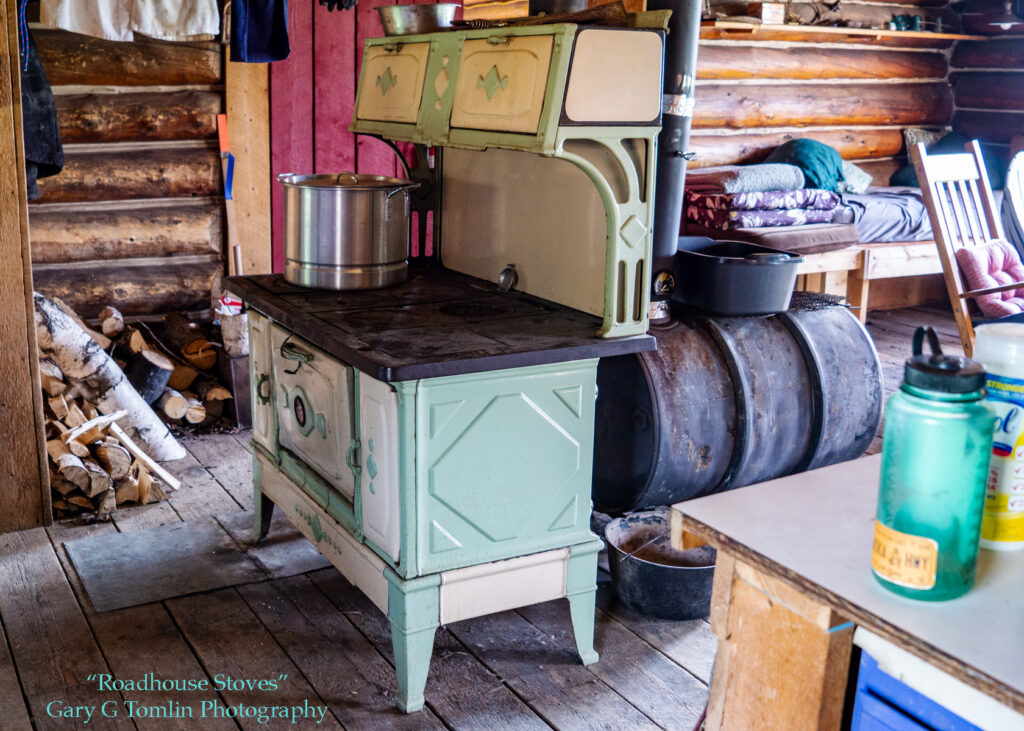
After the gold rush days, a network of roadhouses evolved on the Interior’s trails. They were about a day’s mush apart. A musher could travel all day through the bush, and for a very reasonable price, get a hot meal, a warm dry bunk, and put his team up for the night in sheltered, straw beds. Most are gone, but this one remains at the mouth of the Tolovana River. It’s on the main dog sled trail from the Yukon River to Fairbanks.
The famous, 1925 Serum Run to Nome passed through here. (https://en.wikipedia.org/wiki/1925_serum_run_to_Nome)
The Tolovana has the vibe of a romantic river, although I don’t know why, other than the moose rut, there’s not much romance around these parts.
This roadhouse holds the rich story of the lower Tanana River’s community over the decades.
It operates on the honor system. No fees. Enjoy the kitchen. Sleep in a clean bunk. Leave it cleaner than you found it, and replace any firewood that you burn. There’s a gas stove and the pantry is very well stocked with cooking tools, condiments and staples as people are generous about leaving their over supply for someone else. It’s clean and well protected from pests.
It was an absolute joy to sit in a screened-in porch, on the bank of a mighty river, and watch it flow into the sunset. I’ve never before seen a screened-in porch, on a riverbank, in the Alaska Bush. It is 4-star luxury wrapped in serenity. (See video at end.)
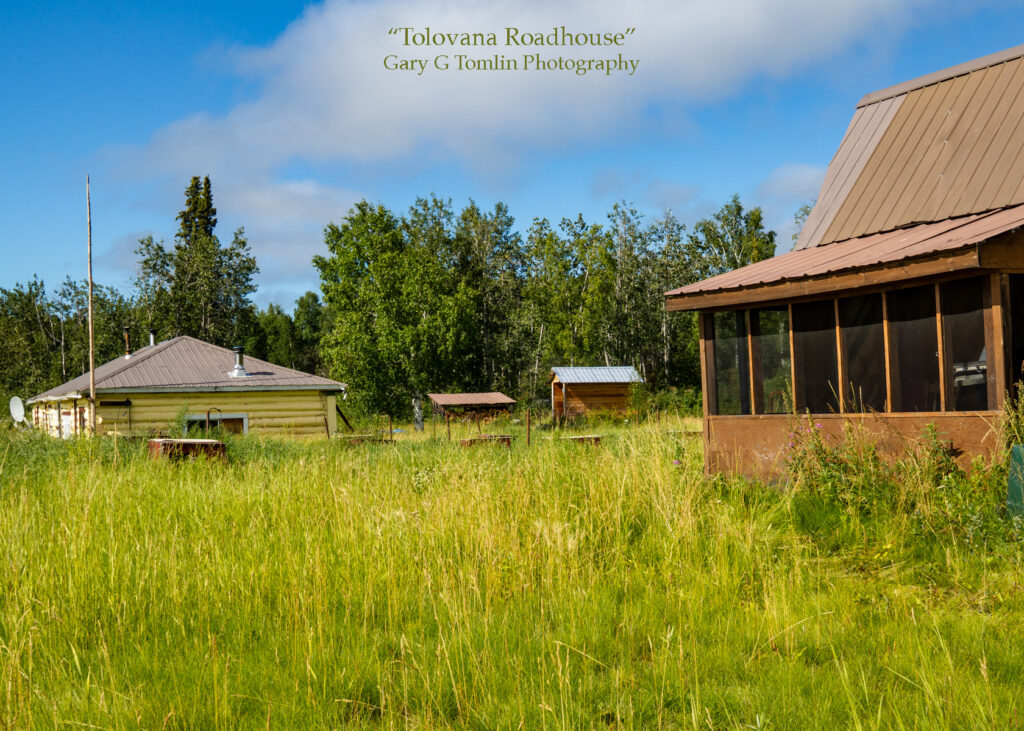
The long yellow building is the Roadhouse. The roofs of a few of the many dog shelters can be seen in the middle, and the small cabin with a porch on the right is where I landed for the night.
On Day 7, I planned to paddle up the Tolovana River an hour or so to get a taste of that. My friend Neil Eklund has a trapline and winter camp up there, and I wanted to check it out and take some photos.
I had hoped to stop and look around the mouth of the Kantishna River, where a small herd of Wood Bison spent last winter climatizing in protective confinement. They were re-introduced to these wilds last spring. The Kantishna is the direct drain off of Mount Denali’s north slope — 60-miles south of here.
I wanted to call on legendary bushman, Charlie Boulding and his family when I paddled past their homestead. “Charlie Boulding, 84, was born in North Carolina. Before moving to Alaska in 1983, he lived in Montana where he worked on an oilrig. He came to Alaska to run dogs and live a subsistence lifestyle.” https://iditarod.com/race/mushers/94-Charlie-Boulding/
I had planned to camp in the open space at Ken and Dee Born’s fish camp at the mouth of Baker Creek. It’s spacious, clean and well appointed — more like a Resort than a fish camp. As I would run out of food, after diner, at this point, I hoped to get an early start on the eighth day and try to get to the Manley Roadhouse before they stopped serving breakfast.
As roadhouses go, Manley’s is the Waldorf Astoria: private rooms with baths, restaurant/ dining room, bar and a collection of art, photos and relics of the times between the gold rush and now.
That was the plan.
—————————————————————-
Speaking of clown acts:
It was about 8 o’clock at night, and I guess I crossed the line-of-site to a tower somewhere, because a text came in from the guys in my coffee group.
We are the senior, volunteer, informal, policy advisory group for our village leaders, and are affectionately called, “The Joint Chiefs of Staff.”
The text advised me that I’ve been out six days, and they think I should be home by now. They are concerned and will call Search & Rescue if I don’t arrive the next day.
They should know I got off of the water for two days of rain — they had the same rain. I had no choice but to accept that my friends must truly believe that I’m not smart enough to come in out of the rain.
Of course, I couldn’t find a signal to answer the text, so I would have to paddle straight through if I was to get the Search & Rescue stopped before it started.
In the morning, the river was fogged in, and it was 11 am before I could get on the water. Paddled hard for 16-hours, and I never got out of the boat. Iron bladder. More Type II Fun. Other than absorbing some of the astounding beauty, the day is a blur in my memory.
—————————————————————-
Night paddle
Dark came at about midnight, and I still had one more hour of the river channel and then two hours of the dead water paddling up the Hot Springs Slough to Basecamp.
The mouth of the slough is obscured from the channel and is easy to miss in the daylight. I knew two landscape markers that helped. The mouth is near the terminus of Bean Ridge as it slopes down to the water, and there is an outcrop of a different strata. Both were recognizable in the dark, but I couldn’t see them until I was right on top of them, and might have missed them had I not been careful, focused and watching.
Once I turned up the slough, It was pitch dark, and I had no help from the current. Paddling required much more energy for this final two hours, and I got rummy in the head from the exertion. My brain mostly stopped working. Thinking was done for this day. I couldn’t see beyond the bow the boat, and I couldn’t reason. This last leg became the most dangerous part of the trip.
Then there was a gift: a faint reflection of ambient light, a soft, narrow beam on the water. The shadows of the forest on either side pinched it down and kept it in the center of the slough. It was like an Angel’s trail.
Nature had me, lovingly, in her hand. It was gentle water, and all I had to do was paddle rhythmically and keep the boat within her glow. It was a dreamy and peaceful state for six river miles.
This pathfinder held strong until I got to the bridge in Manley, and then for the last half mile, it went completely dark. At one point before I finished, I paddled right into the leafed branches of a recently fallen birch tree. That woke me up.
—————————————————————-
The Third Clown Act: ducks
Last spring, one of my neighbors bought four domestic ducklings and let them loose in the slough. All summer long they have been swimming up and down, making noise, being funny and growing up. They can’t fly, and it seems that everyone on the slough feeds them.
The bank at Basecamp is too steep and overgrown to land a boat, so my destination was neighbor Ken Taylor’s landing. He has a slope graded down to the water, and he’s very generous with his assets.
There was only one place along the shore wide enough for me to land because of the all the other boats parked there, and those ducks were huddled up and sleeping in the middle of it. I tried ordering them to move.
Four fat ducks were keeping this ordeal from being over. I’m not fluent in Duck, but I understand it well enough to know they were telling me to piss off. They were warm, dry, comfortable, secure and not going to move.
This wasn’t making any sense to my rum-dummy head. I carry a five-shot revolver. The chamber is empty. Four bullets — four ducks. Shooting them seemed to be the preordained solution, however, I had the presence to realize that Ken’s house was directly behind them and in the line of fire. I discarded that idea. Shooting up your neighbor’s house in the middle of the night is an unforgivable sin, and I was pretty sure Ken would shoot back.
I started splashing water on them with my paddle, threatened them with murder and called them names that rhymed with duck. They got up and got out of the way. They bitched loudly about the indignity, as they swam around in a tight cluster.
After I claimed their warm real estate, they came back to shore and found another spot to huddle up.
—————————————————————-
I arrived at 2:30 am and group-texted the Joint Chiefs that I was at the landing, safe, and to call off the Search & Rescue. One responded within a few minutes that he had called the State Troopers’ dispatch and had done so. He said the helicopter’s pre-flight had been scheduled for 6:30 am.
I crashed for a few hours. I wanted to show my face at the Roadhouse when the restaurant opened and stop the inevitable, small town, rumor mill.
As I was eating breakfast, some guy I didn’t know, came in and announced, “That guy who is lost on the river — they found his canoe, without him, down near the Yukon.”
“What’s this about,” I asked.
“Yes.” the Rumor Monger said, “Some guy started out in Fairbanks, 10 days ago, and he only had five days of food. They’ve been searching for him. It doesn’t look good.“
“Sumbitch,” I said, “Do you think he might have been sitting out the rain in a tent for a couple of days?”
“Naw. I heard he’s not that smart.”
# 30 #
Listen for the sound of the rocking chair.
3 responses to “A Messy Trip Down the Tanana”
This is a riveting narrative of your trip! The video and the photos help tell your story, but the best brush strokes of this piece of art in in your words. Superb!! A book in the making! I want a signed copy!
Always riveting reading and so interesting. To me it’s scary since I know you, Gary keep safe and keep writing. I pray for you. A Pat.
You can sure tell a great story. For a while I thought I was in the boat with you. You actually swore at a duck to move…from his own habitat?